
Available now
Learn Brazilian Portuguese online
Learn Brazilian Portuguese from A1 to C1 through everyday situations, culture, stories and literature between Brazil and Berlin.

Pick who you'll travel with
Live courses
- A1
Portuguese A1 for English speakers · Priya in São Paulo
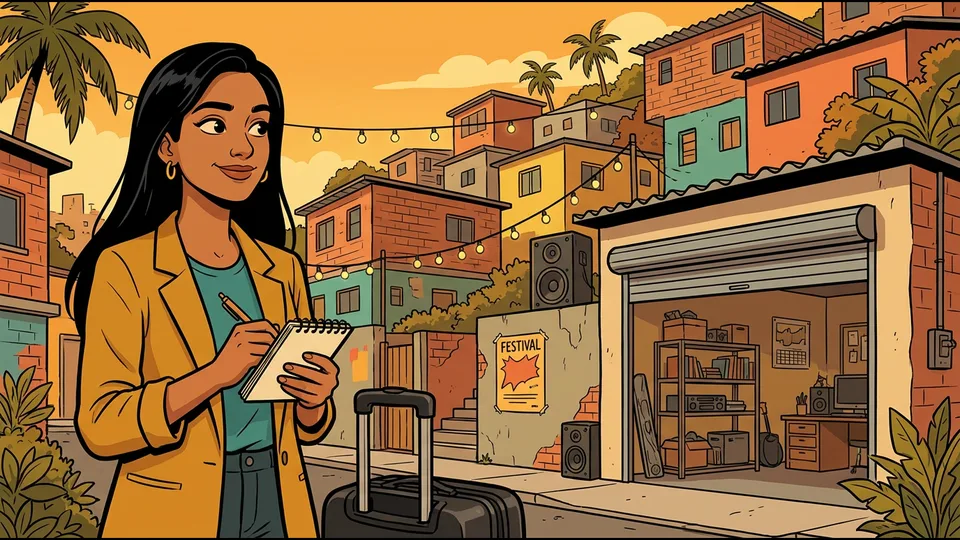
Brazilian Portuguese from scratch for English speakers. Follow Priya, a London producer spending a year in São Paulo co-producing a festival with a company from the periphery. Explanations in English, the traps English speakers fall into, three study rhythms.
12 Lessons live
Open the course - A2
Portuguese A2 for English speakers · Priya in São Paulo
The second step for English speakers: Priya and Fervo Produções in the rush to produce the Festival Travessia. Suppliers, the team, a flat, a doctor's visit, rain and homesickness. The past, comparisons, advice and polite requests, explained in English.
12 Lessons live
Open the course - B1
Portuguese B1 for English speakers · Priya in São Paulo
The third step for English speakers: the Festival Travessia happens, and then the aftermath. A canceled band, the press, a sponsor's contract, a row in the team, the accounts and an invitation to stay in Brazil. The subjunctive, hypotheses, the passive and reported speech, explained in English.
16 Lessons live
Open the course - B2
Portuguese B2 for English speakers · Priya in São Paulo
The fourth step for English speakers: the year between the first and second Festival Travessia. A sponsor who walks away, the city's funding call, the residents' association, a debate on who wins from the festival, a critical column, a serious row with Ray, a partnership and a visit from Priya's mother. Every subjunctive tense, the personal infinitive, the passive and formal register, explained in English.
16 Lessons live
Open the course - C1
Portuguese C1 for English speakers · Priya in São Paulo
The last step for English speakers: Priya, now a partner at Fervo, prepares the second edition of the Festival Travessia. Leading the team, a panel debate, a long podcast interview, a signed opinion piece, a trip to Caruaru, Brazilian irony and euphemism, the crisis on the eve, the closing speech and the decision to stay in Brazil. Register, pronoun placement, the personal infinitive and nuance, explained in English.
16 Lessons live
Open the course
What you'll learn
5 courses and 72 lessons, about 18 hours of study at level A1–C1. The list comes from the lessons that are live: when a new lesson goes up, it shows up here.
Level A1
12 lessons · about 3 h
- 1Chegada · Arrival: First days in São Paulo: say who you are, meet the team, buy your first SIM cardModule 1 · 3 lessons · 36 min
- 2O dia a dia · Everyday life: Order lunch, find your way and talk about your day in São PauloModule 2 · 3 lessons · 36 min
- 3Gente da Vila · The neighbourhood: Family, likes and describing people: the Vila Esperança crewModule 3 · 3 lessons · 36 min
- 4O festival começa · The festival begins: Invitations, plans and Priya's first speech to the neighbourhoodModule 4 · 3 lessons · 36 min
Level A2
12 lessons · about 3 h
- 1O corre começa · The hustle begins: Suppliers, quotes and the team rota: the festival production starts for realModule 1 · 3 lessons · 42 min
- 2Casa, saúde e papelada · Home, health and paperwork: A flat of her own, a sore throat and a permit at the counterModule 2 · 3 lessons · 42 min
- 3Imprevistos · Things go wrong: A storm at the test event, a weekend to tell, and a Sunday of homesicknessModule 3 · 3 lessons · 42 min
- 4Reta final · The final stretch: Advice, a radio interview and the night before the Festival TravessiaModule 4 · 3 lessons · 42 min
Level B1
16 lessons · about 4 h
- 1Portões abertos · Gates open: Festival Saturday: the opening, a cancelled band, the press and Dudu's showModule 1 · 4 lessons · 60 min
- 2Domingo de festival · Festival Sunday: A sponsor's contract, a row in the team, a fallen tent and the closing broadcastModule 2 · 4 lessons · 60 min
- 3Depois da festa · After the party: The debrief, the accounts, a formal e-mail and what the neighbours really thoughtModule 3 · 4 lessons · 60 min
- 4Ficar ou voltar · Stay or go home: An offer, two phone calls, Priya's own story and the first meeting about next yearModule 4 · 4 lessons · 60 min
Level B2
16 lessons · about 4 h
- 1Na mesa de negociação · At the negotiating table: A sponsor who wants the name, a deal that falls through, the city's funding callModule 1 · 4 lessons · 60 min
- 2Barulho na praça · Noise in the square: The residents' association, a public debate, a harsh column and a public replyModule 2 · 4 lessons · 60 min
- 3Dinheiro e controle · Money and control: A decision made alone, a row over lunch, rules on the rooftop and a signatureModule 3 · 4 lessons · 60 min
- 4A segunda edição · The second edition: The funding application, a visit from Leicester, a goodbye at the airport and the resultModule 4 · 4 lessons · 60 min
Level C1
16 lessons · about 5 h
- 1Sócia · Partner: Leading the second edition: delegating, hard feedback, the funding report and the planModule 1 · 4 lessons · 72 min
- 2Voz pública · Public voice: A panel debate, a long podcast interview, an opinion piece and a columnist's replyModule 2 · 4 lessons · 72 min
- 3Entrelinhas · Between the lines: Caruaru, irony at the bar, a polite ‘no’ and a crisis on the eveModule 3 · 4 lessons · 72 min
- 4A decisão · The decision: The closing speech, a letter to London, a call with Meera and Sunday lunchModule 4 · 4 lessons · 72 min
Who it's for
- Complete beginners who want to start from zero and are fine with mistakes.
- People who tried before, got stuck and want short lessons that fit the day.
- Anyone who needs the language for work, travel or a move abroad.
- If you already know a bit, the free placement test shows where to start.
How it works
Every lesson follows the De Quebra Cycle: you hear a scene from the series, work out what happened, practise speaking and writing, and finish with a real-world mission.
Pick your pace before you start and switch any time:
- De boa (easy): just the essentials, translation close by, extra support.
- No corre (standard): the full lesson. Most people pick this one.
- Modo Nerdrake (intense): everything, plus deeper grammar, bonus reading and a challenge without translation.
Frequently asked questions
- Is it really free?
- Yes. All 72 lessons are open at no cost, and lesson 1 opens with a 30-second sign-up. A free account saves your progress. The Gold plan is optional: feedback on what you say and write, plus live classes with the teacher.
- Do I get a certificate?
- Yes. At the end of each course there's a 10-question assessment; pass with 70% and you get a certificate of completion right away, with study hours and a verification code. It's a school certificate, not an official proficiency exam.
- How long does it take?
- The whole ladder (A1–C1) has about 18 hours of lessons. Each lesson takes 5 to 20 minutes, so one a day keeps you moving. Fluency depends on how much you practise, and nobody honest promises a deadline.
- Does it work if I'm starting from zero?
- Yes. The first course starts with greetings and explains everything in your language. If you already know some, the free placement test points you to the right course.
- Do I need to download an app?
- No. Everything runs in the browser, on your phone or computer. The audio plays right inside the lesson.
- What level will I reach?
- The courses follow the Common European Framework (A1, A2, B1, B2 and C1), the scale schools, employers and visas use. Each course closes one step.
Ready to start?
Lesson 1 opens now, with a 30-second sign-up. Want feedback and live classes? Check the plans.
- 01See
Video, audio, image or literature.
- 02Unpack
Vocabulary, pronunciation, grammar and context.
- 03Practice
Short, focused exercises.
- 04Create
Your own answer, in text or audio.
- 05Take it to the world
A practical mission tied to real life.